Mathematics · Human-centred design
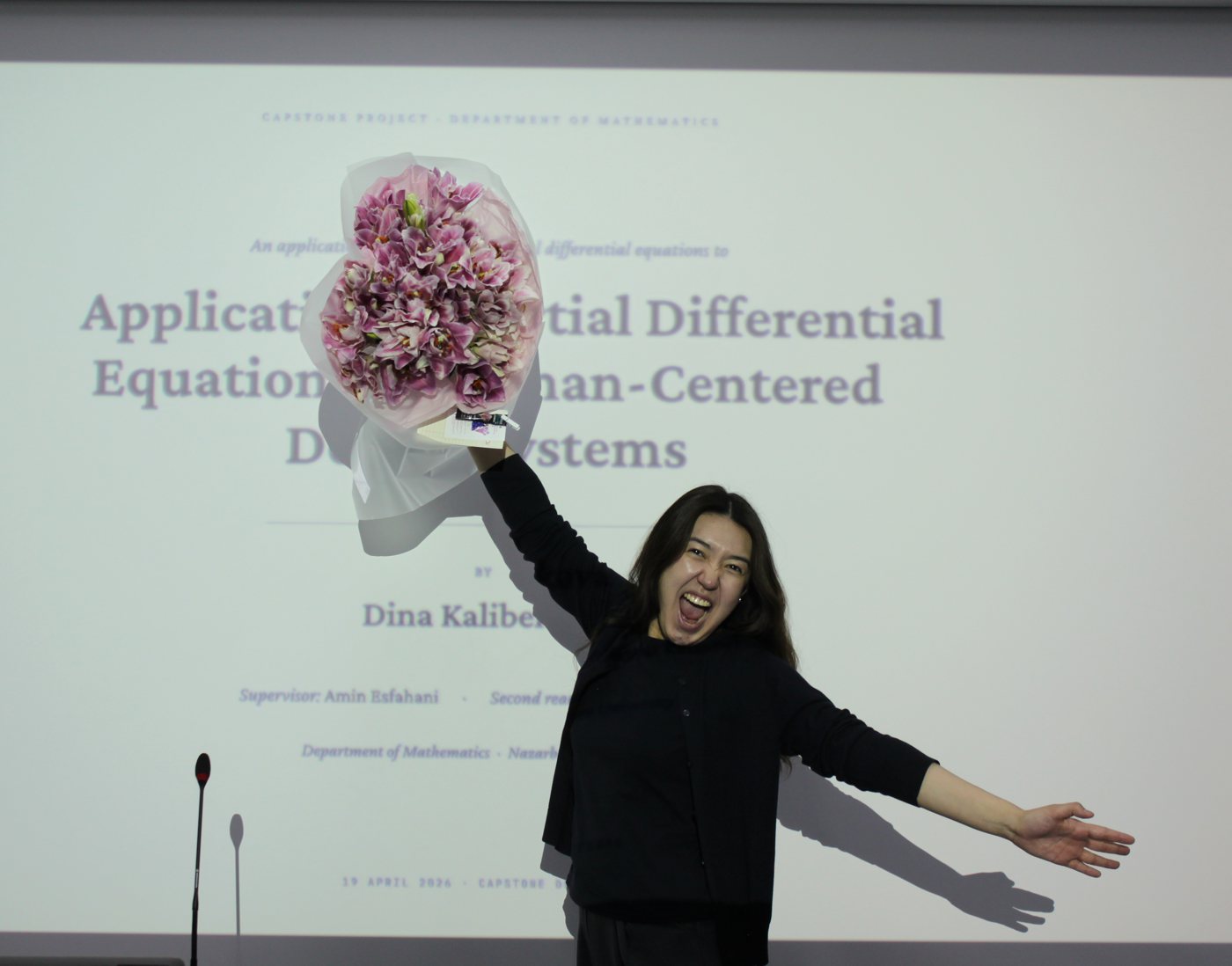
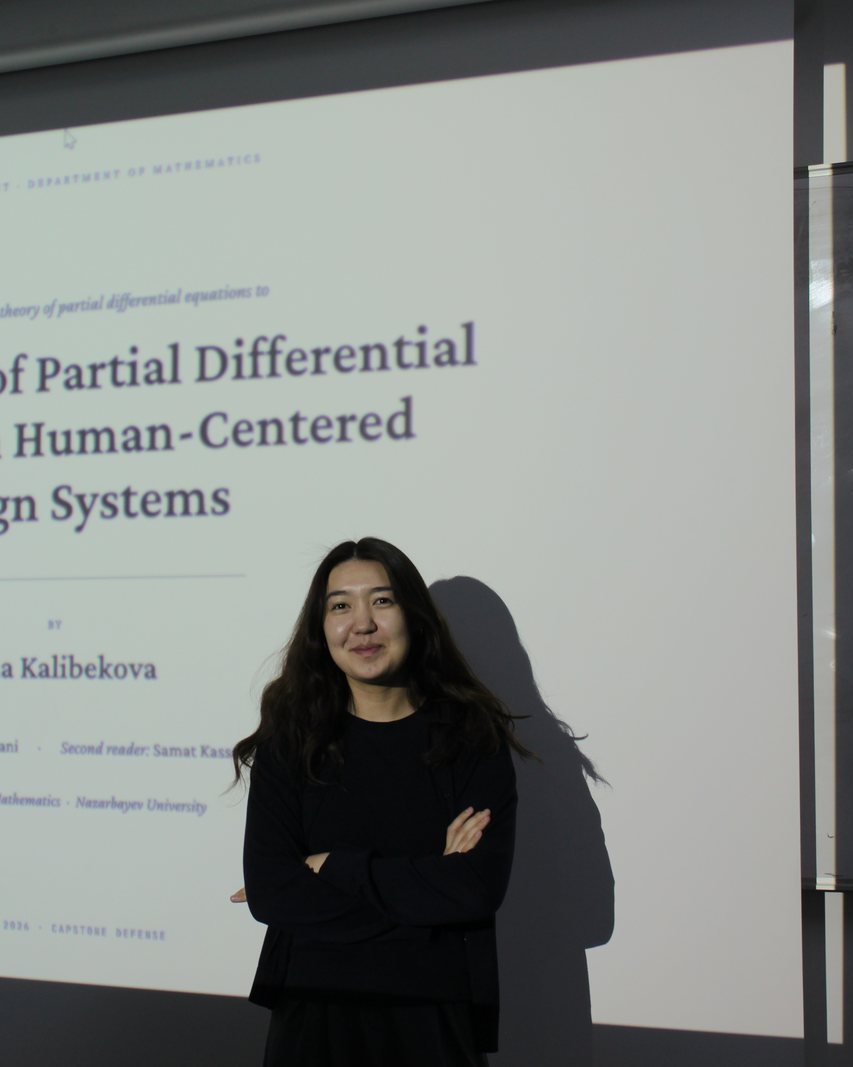
Application of Partial Differential Equation in Human Centered Design Systems
Description
My maths capstone, where I went looking for the role of mathematics in design. I modelled two flows with the same kind of equation, floodwater and a crowd of people, and joined them into one answer a planner can use: how deep the water can get before a street is no longer safe to escape through.
Project details
- Date:
- Spring 2026
- Team:
- Solo · supervisor Amin Esfahani, second reader Samat Kassabek
- My role:
- Author · Mathematics capstone
Abstract
Human-Centered Design (HCD) is a concept that prioritizes people-oriented solutions, focusing on sustainability and safety. Partial differential equations are used to model different physical concepts, like fluid dynamics and flow behavior. In this capstone, we considered two cases, urban flooding and pedestrian flow, and connected them, taking into consideration HCD as the main idea. The urban flooding model was based on the Shallow Water Equations and simplified to a 1D steady-state solution, while the crosswalk pedestrian flow was based on the Hughes model and also reduced to 1D steady-state conditions. To mathematically connect these two cases, this research derived the relationship , which links the physical parameters of the flood to the pedestrian crowd dynamics. The increase in floodwater depth h artificially reduces the available safe walking space, forcing the local pedestrian density ρ of the “thinking fluid” to increase. Quantitative results revealed a critical capacity threshold of 50% for crowd density (ρ = 0.5); after exceeding it, pedestrians lose their safe free-flow state. Both cases are based on the same class of equations, called conservation laws. The “thinking fluid” in the pedestrian case represents the flow of people, analogous to the water flow in urban flooding. By connecting these two cases, this research provides urban planners with a quantitative tool to assess whether evacuation routes remain safe during urban flood emergencies.
The question
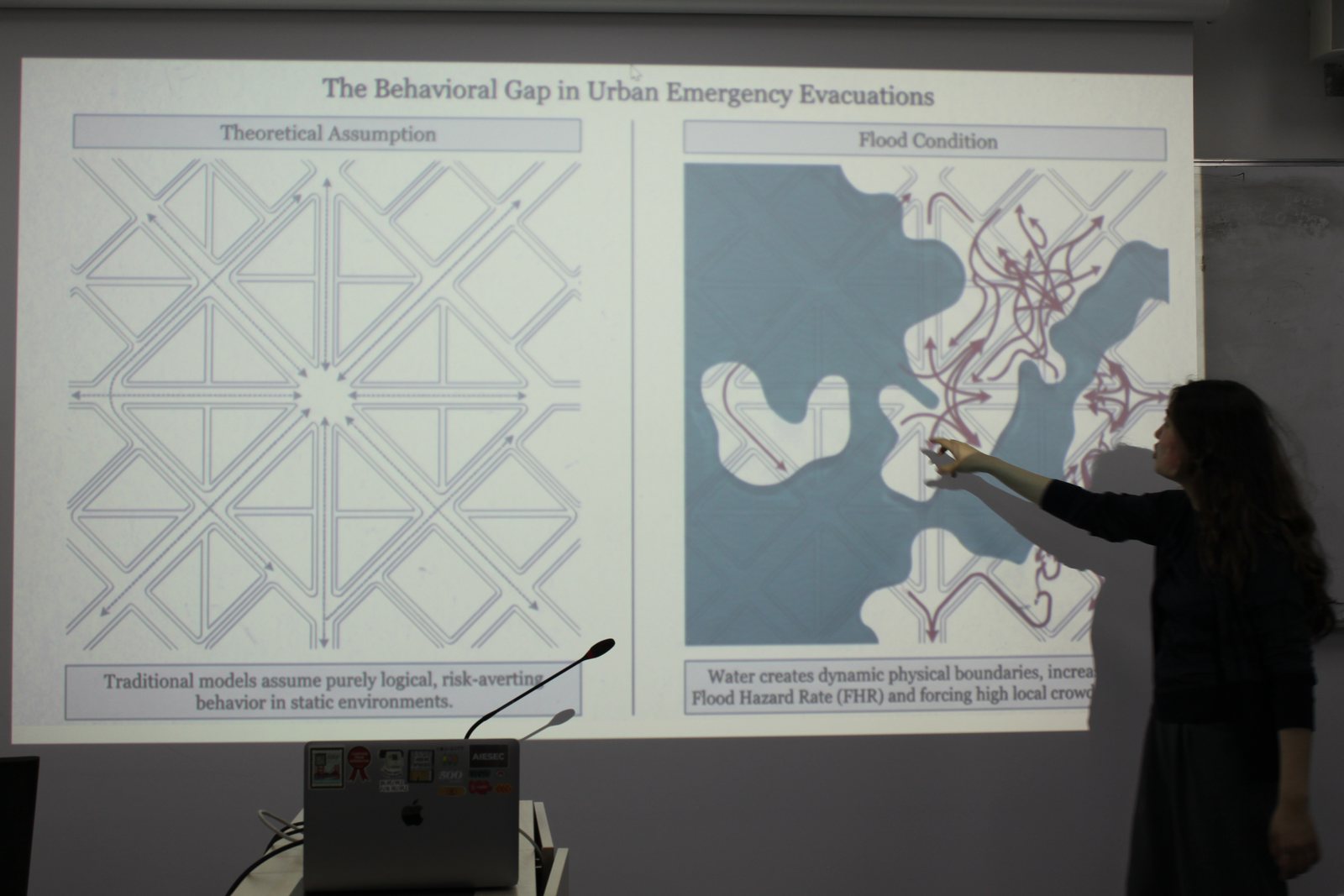
Evacuation routes are planned for a dry street, and for people who move the way the plans expect. In a flood the water takes the edges first, and people follow family and friends, not the optimal route.
How might weuse the equations of flow to design streets that people can still escape through in a flood?
What I did
One law for both
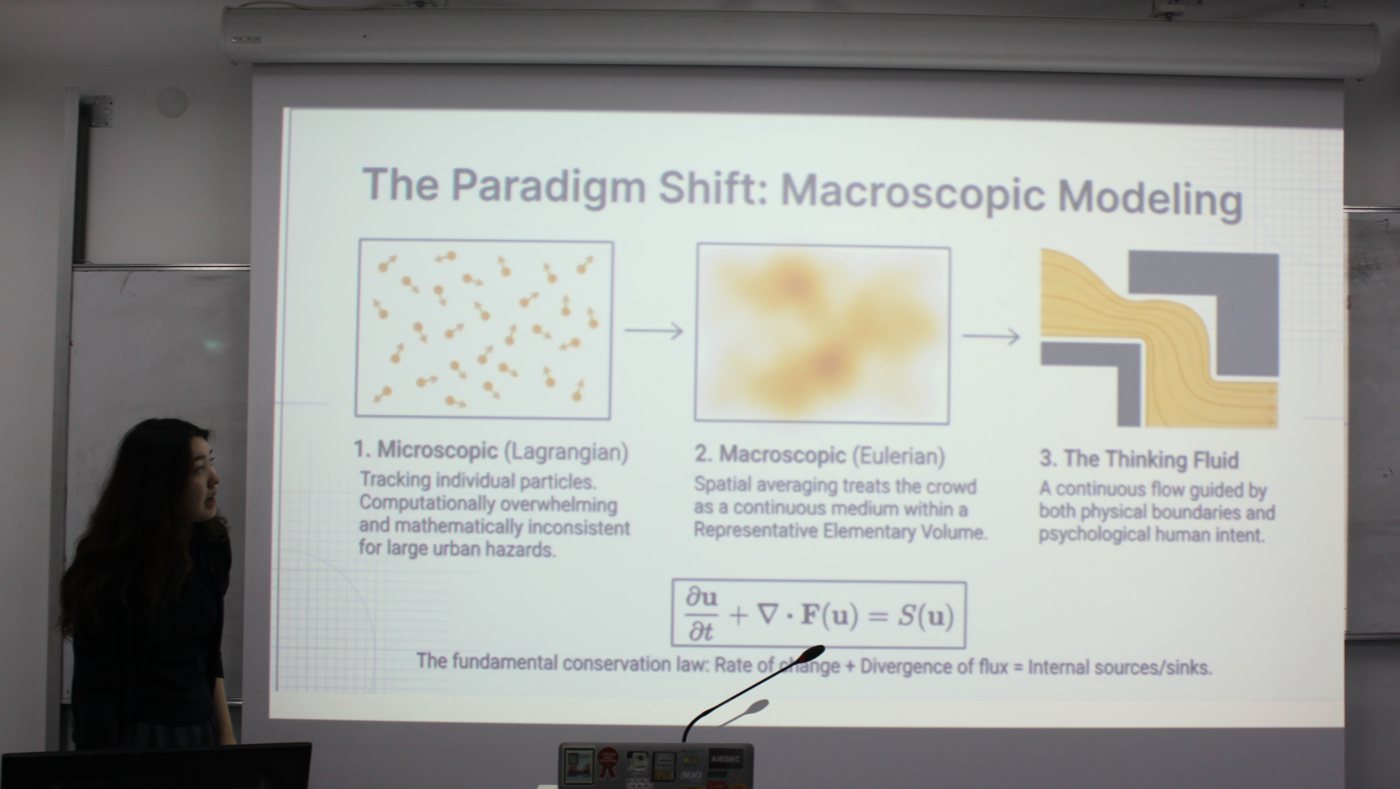
Water and crowds follow one conservation law, so I modelled both as a fluid.
MoreLess
Water and crowds obey the same rule, a conservation law: what flows in either flows out or stays. I derived it from the start, through the divergence theorem, and treated both as a continuous fluid instead of one drop or one person at a time.
The water
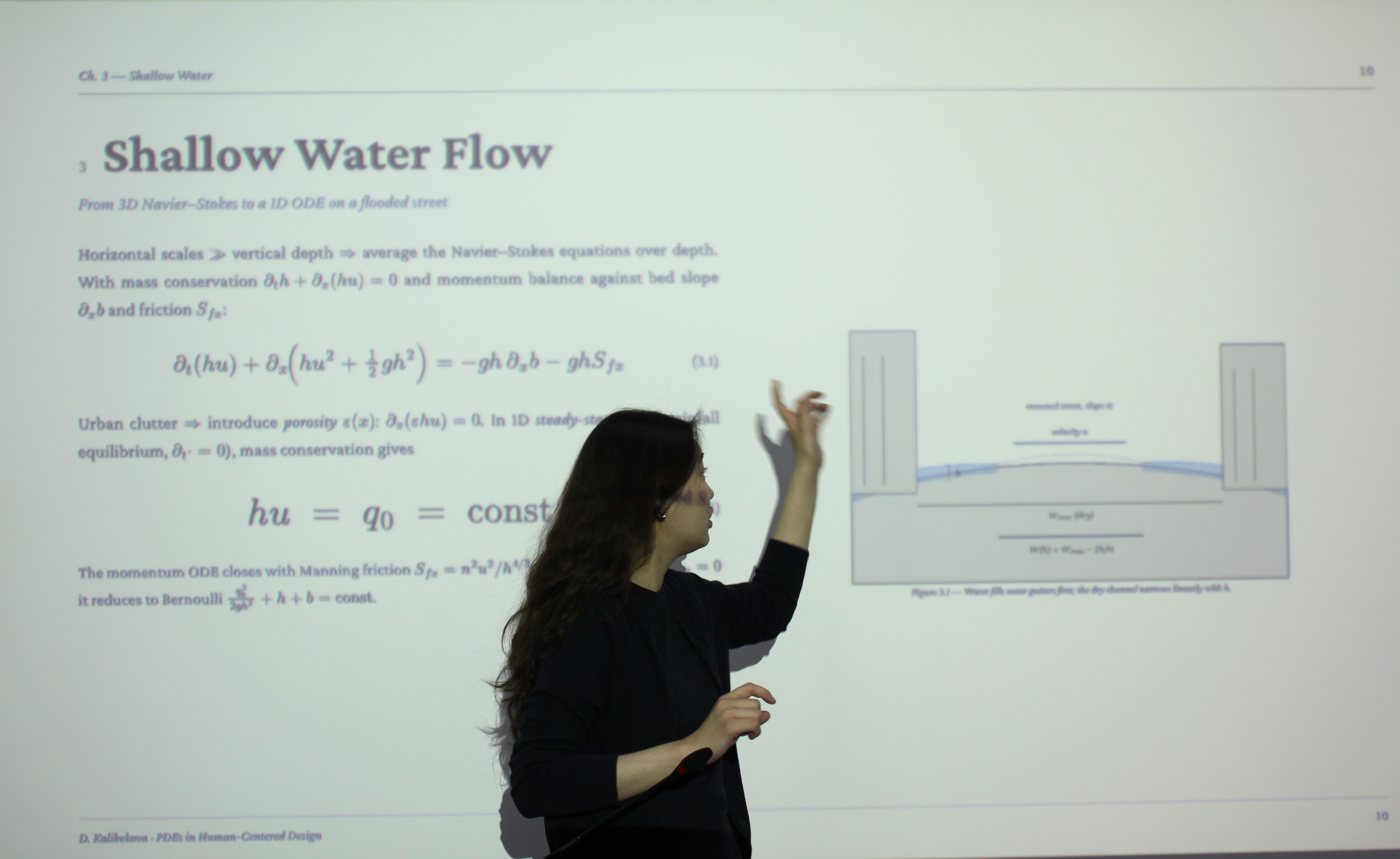
The shallow water equations, solved by hand for one street at the flood's peak.
MoreLess
The shallow water equations, reduced to one street at the peak of the flood and solved by hand: the flow along the street stays constant, hu = q₀. A porous version accounts for the buildings in its way.
The people
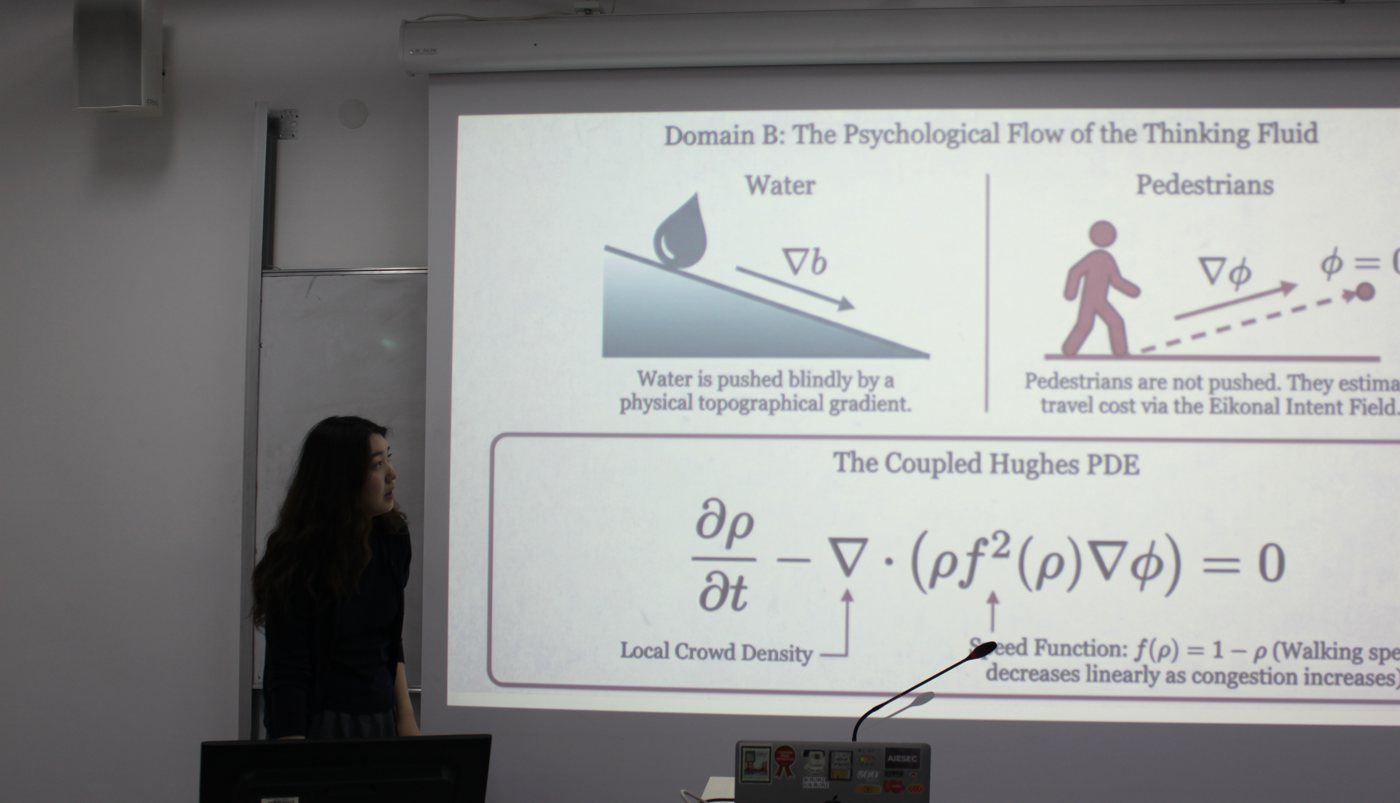
The Hughes model: a crowd as a “thinking fluid”, which gives q = ρ(1 − ρ).
MoreLess
The Hughes model treats a crowd as a “thinking fluid”: everyone heads for the exit by the cheapest route and slows down as it gets crowded. On a straight crossing it becomes q = ρ(1 − ρ).
The join
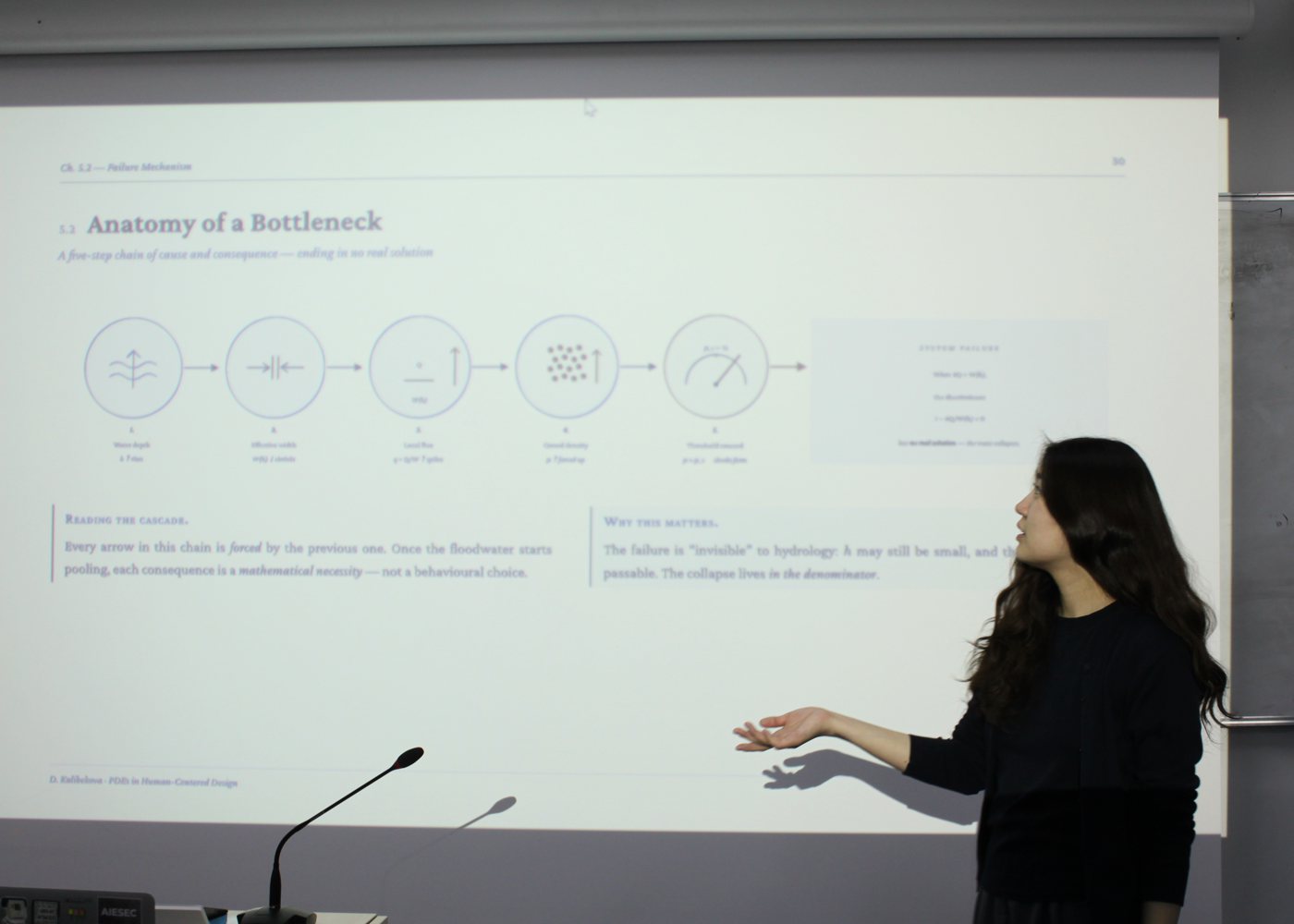
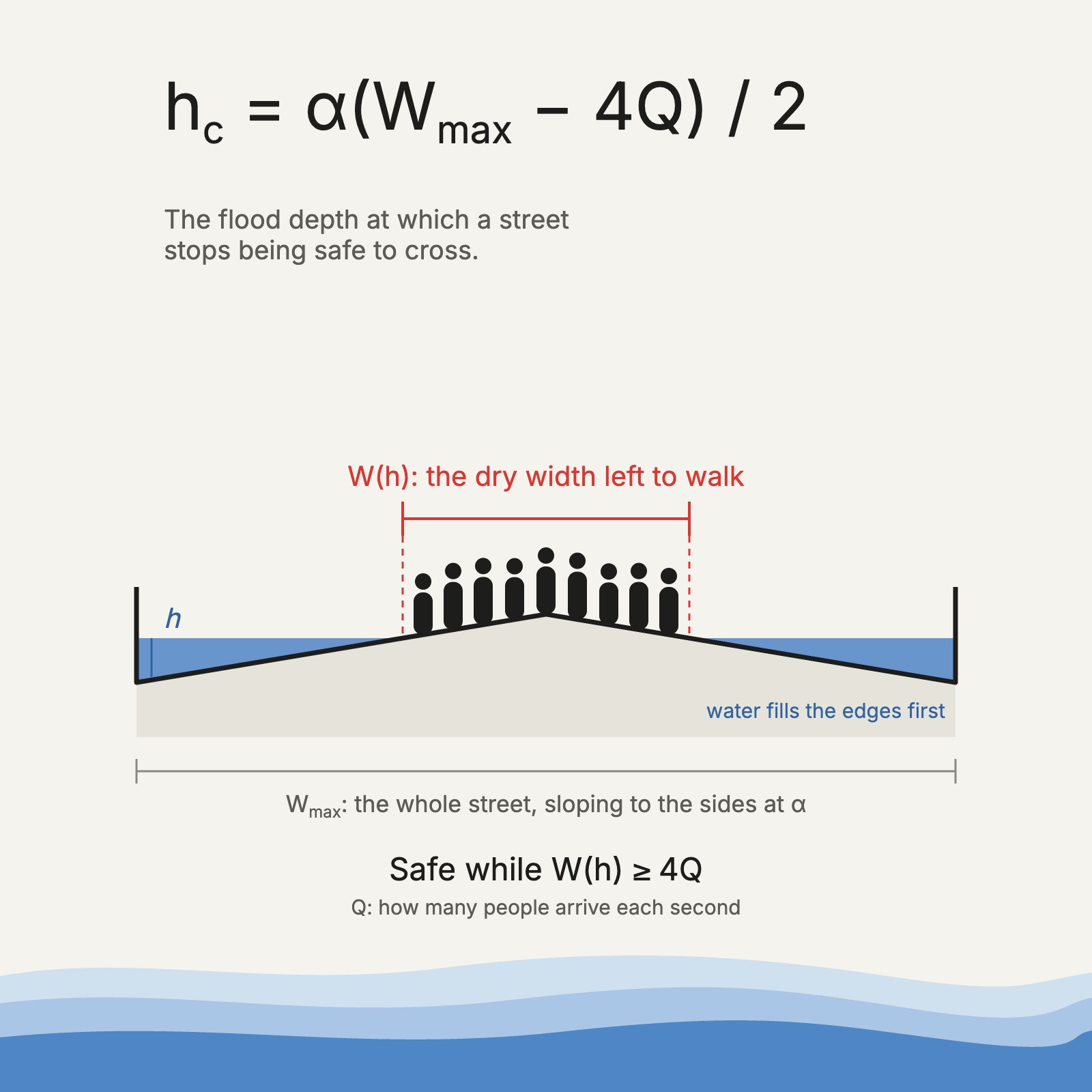
Rising water narrows the dry street, and the same crowd has to fit: .
MoreLess
A street is higher in the middle, so the water takes the edges first. As it rises, the dry width shrinks, W(h) = Wmax − 2h/α, and the same crowd has to fit into it.
Read it as a designer
For every result I asked who is most at risk, and what could be built to help them.
What I found
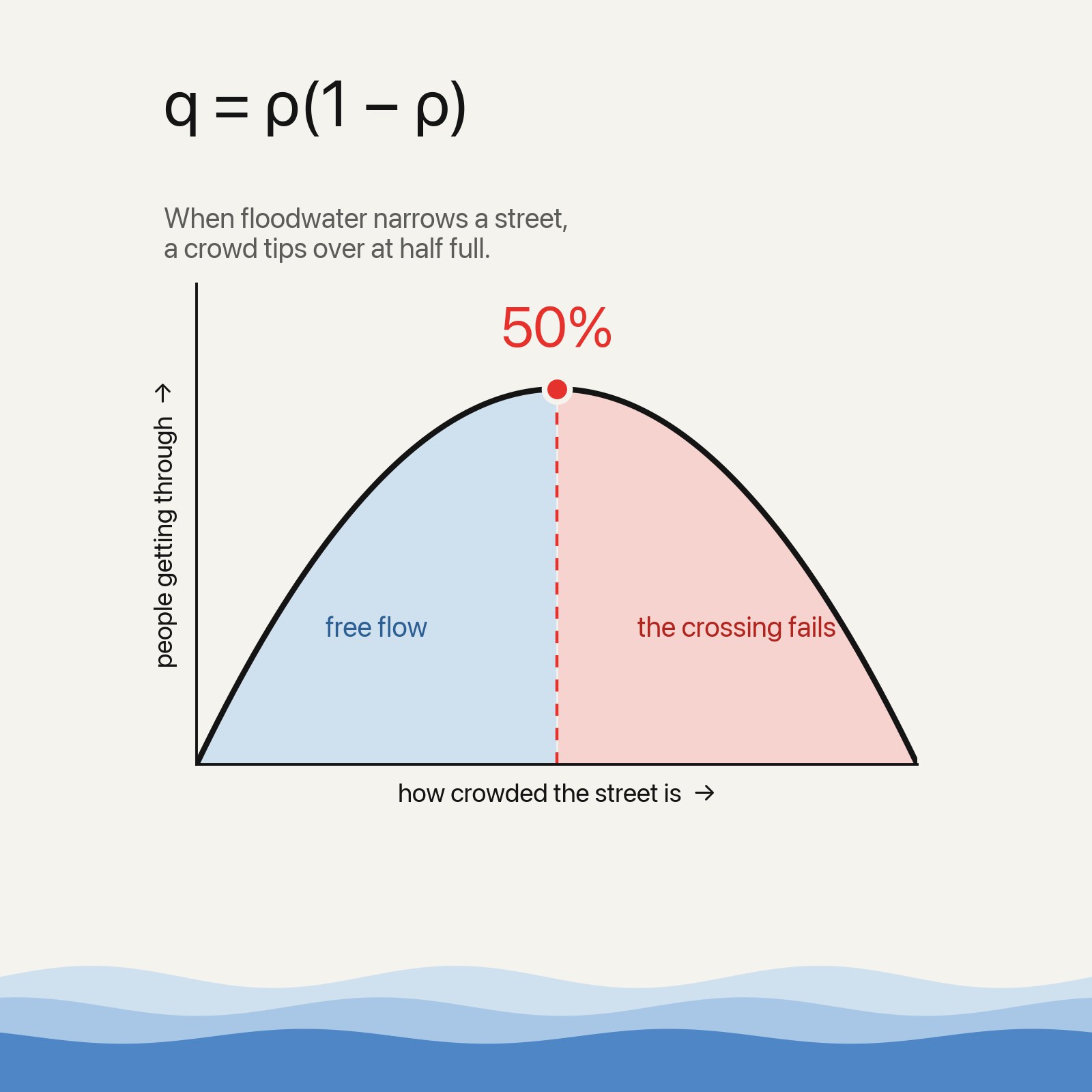
Below half full, people walk freely. Above it, one person slowing down sends a wave back through everyone behind, like brake lights, and fewer get through though more are trying. Joining the two models gave a critical flood depth: the water level at which a street stops being safe to cross, so a city can warn people early or send them another way.
It also says what to build: raise the pavement, widen the crossing, add islands so the two directions don't collide, paint arrows to steer people into lanes, and time the green light so the crowd never fills past half.
- 50%
- how full a crossing can get before it starts to fail
- ¼
- the most a crossing can carry, for each unit of dry width, and still flow freely
- W ≥ 4Q
- how much dry width a crowd needs to get through safely
Looking back
Limits
One street at the peak of the flood: real floods come from several directions, real crowds cross both ways, and corners and doorways jam in ways a straight line can't show. The model also assumes everyone walks alike; a real crowd, with children and older people in it, reaches its limit sooner.
What's next
Two-dimensional models, solved numerically, and one day a live version that reads street photos and sensors during a storm and suggests the safest routes.